Blood donation tools
Can I donate blood today?
Answer the questions below and in seconds you will know whether you can donate now, and if not, why and when to try again. We do not ask for your name or email, and we do not save your answers.
This tool gives general guidance based on published rules, which differ by country and change over time. It does not replace a medical assessment. The doctor at the donation centre always makes the final decision. In an emergency, call your local emergency number.
The basic requirements to donate blood
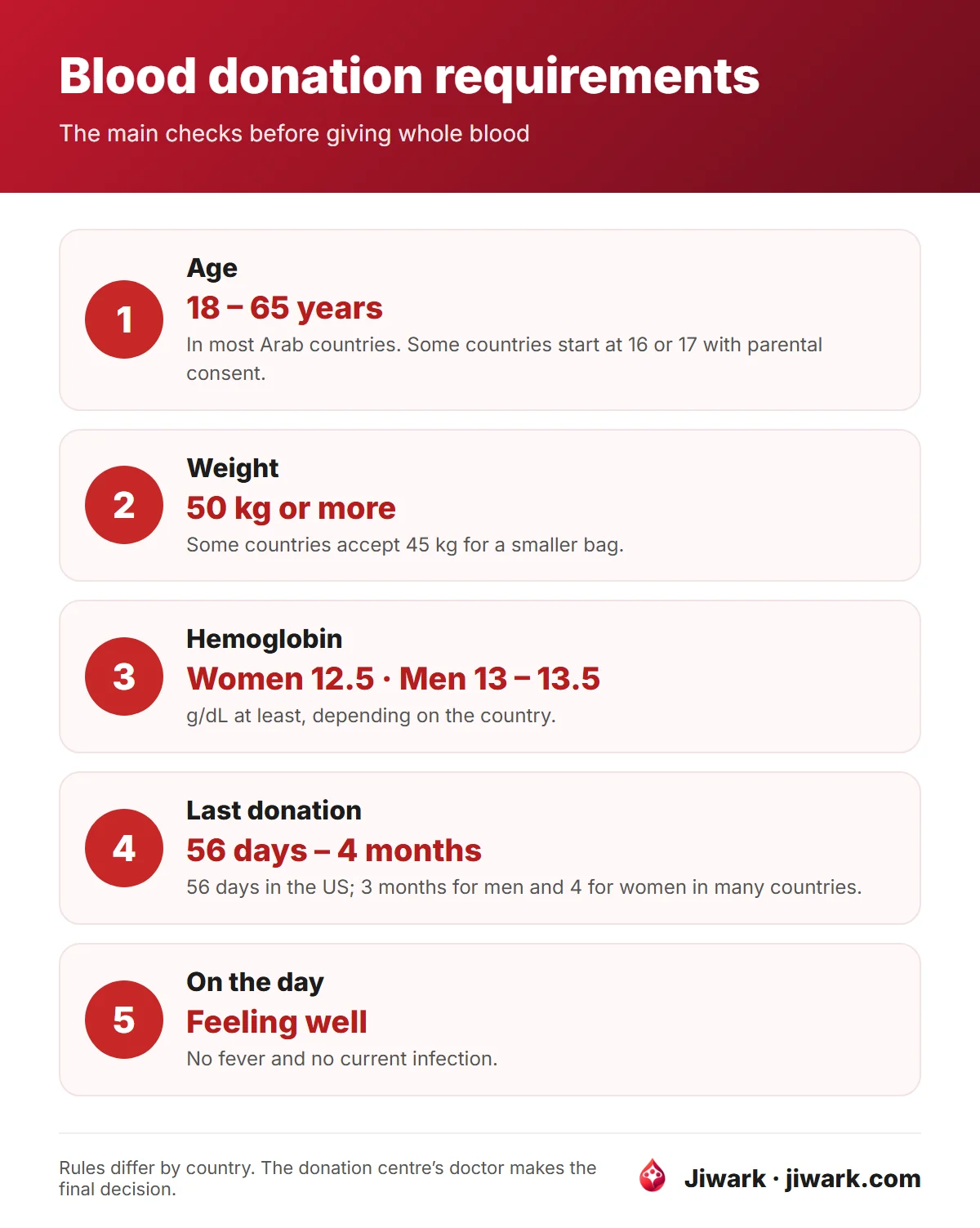
These are the rules this check uses, and they are close to what most donation centres ask:
- Age 18 to 65 in most Arab countries. Some countries accept 16 or 17 with parental consent, and some centres accept older donors with a doctor’s approval.
- Weight of 50 kg or more (some countries accept 45 kg for a smaller bag).
- Hemoglobin of at least 12.5 g/dL for women, and 13.0 to 13.5 g/dL for men depending on the country.
- At least 56 days since your last whole blood donation (the US minimum); many countries ask for 3 months for men and 4 for women.
- Good health on the day: no fever and no current infection.
Work out your next donation date
Reasons for a temporary delay
A cold or fever, antibiotics, dental surgery, tattoos and cupping, major surgery, a blood transfusion, pregnancy and childbirth, and some medicines such as Roaccutane. All of them pass with time, and the wait differs from country to country.
Reasons for a permanent ban
HIV or hepatitis B or C, and injecting drugs. The reason is always to protect the patient who will receive the blood.
What happens on the day?
Your details are recorded and you answer a short health questionnaire. A nurse then measures your hemoglobin with a finger prick, and your blood pressure and pulse. About 450 ml of blood is then collected in roughly 8 to 10 minutes, and you rest and drink fluids. The whole visit takes about half an hour.
Before and after donating
Sleep well, eat a light meal and drink plenty of fluids before you go. Afterwards rest a little, drink more than usual, avoid hard exercise and heavy lifting for the rest of the day, and eat iron-rich foods such as meat, legumes and leafy greens.
Frequently asked questions
Can I donate while fasting?
It is best to donate when you are well fed and hydrated, because fasting makes dizziness after donating more likely. In Ramadan many centres accept donors after iftar, so ask the centre for its hours.
Can I donate after a tattoo or cupping?
It depends on the country: 3 months in the US, about 4 months in the UK, and 6 to 12 months at many centres in the Arab world. Rules for cupping vary from country to country. Ask the centre before you go.
Can I donate if I have high blood pressure or diabetes?
It depends on how well the condition is controlled and on the medicine. Many people with controlled blood pressure or diabetes donate with the doctor’s approval, while uncontrolled cases are deferred. Leave the decision to the centre’s doctor.
Does donating weaken the body?
Not in healthy people. The body replaces the fluid within hours and the red blood cells within weeks, which is why there is a wait between donations.
What if I do not know my hemoglobin?
No problem. Leave it empty and the centre will measure it before you donate with a finger prick. If it is low, no blood is taken.
Sources
This tool is based on the published guidelines below. Some rules differ between countries, and the donation centre in your country has the final word.
- Blood donor selection: guidelines on assessing donor suitability for blood donation World Health Organization
- Blood Donation Eligibility Requirements American Red Cross
- Whole Blood and Component Donor Selection Guidelines UK Blood Transfusion Services (JPAC)
- عملية التبرع بالدم MSD Manuals
Content and links last reviewed: 17 October 2026. How we write the tools
More tools that may help
-
When can I donate again?
Enter your last donation date and see the day you can donate again.
-
Child’s blood type predictor
Pick both parents’ blood types to see which types the child can and cannot have.
-
Blood type compatibility chart
Pick a blood type to see who it can help and who it can receive from. Share the link with a type picked to show someone their matches.
-
Blood donation guides
Short answers to the most common questions about giving blood.
Sign up as a donor and be ready when someone needs you
Jiwark reminds you of your next donation date and alerts you only when someone in your city needs your blood type. Signing up is free.